
By: Mark Zohar
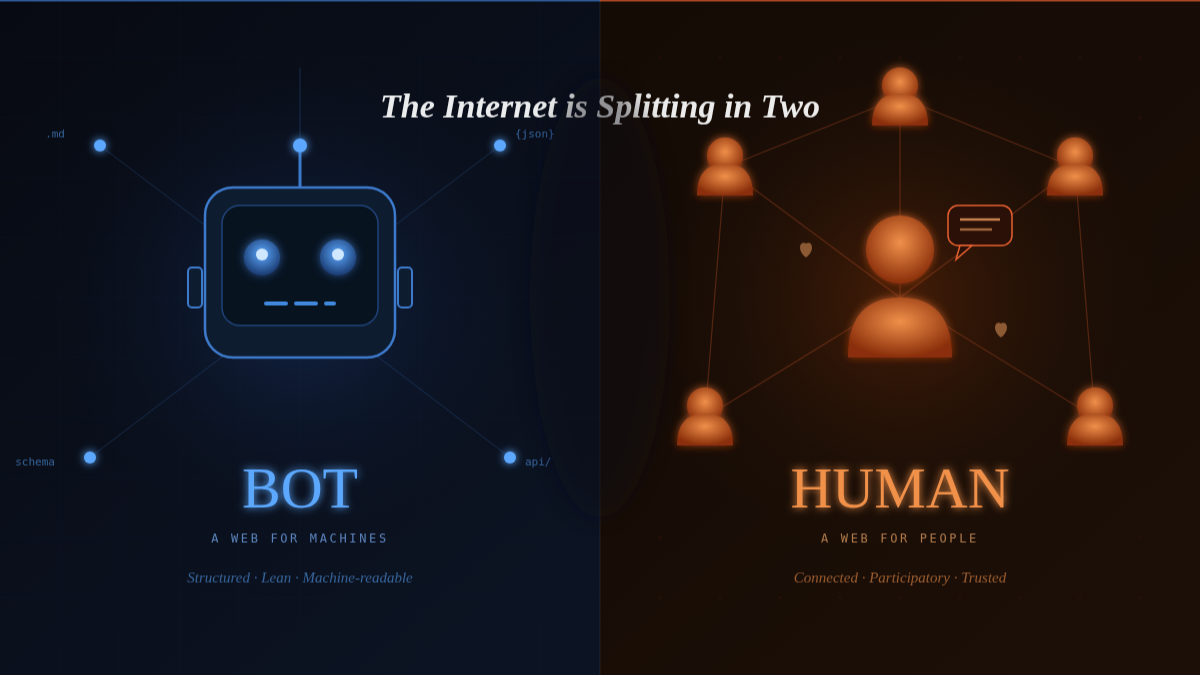
The Internet Is Splitting in Two
For the first time in the web’s history, bots now account for more than half of all traffic. And they’re expensive. Akamai’s AI Botnet Report found AI bot activity surged 300% last year, hitting media and publishing hardest. These automated visitors consume significant server and CDN resources while delivering zero engagement, driving up costs and degrading performance for the humans you actually want.
Search crawlers, AI answer engines, agentic systems: they don’t need your navigation, your hero images, your carousels, or your pixel-perfect polish.
They need structure. Speed. Signal.
Which means publishers are quietly facing a decision they haven’t fully named yet: you need two websites.
The Bot Site
A lean, markdown-rendered, machine-readable layer of your content. Structured data. Clean taxonomy. Minimal infrastructure cost. Optimized not for dwell time or scroll depth, but for ingestion and interpretation by systems that will never care about your brand font.
And there’s an offensive reason here, not just a defensive one. The bot site is how you stay visible in the AI answer layer. Feed the machines clean, structured, attributable content and you get cited, surfaced, and linked. Starve them, and you disappear from the place where more and more discovery now happens.
But visibility without compensation is just a faster way to give your work away. The bot site is also where publishers draw the line on IP — through access controls that govern who gets in, licensing models that turn ingestion into revenue, and metered toll booths that charge AI answer engines for the crawling and scraping they currently do for free. The question isn’t whether bots will consume your content. They already are. The question is whether you’re being paid for it.
This isn’t a hypothetical. It’s already happening. Publishers who understand this are building an API-first content layer alongside their consumer site. The ones who don’t are serving a rich visual experience to an audience that has no eyes.
The Human Site
Here’s where it gets more important.
If bots get the markdown version, what does the human version become? The answer shouldn’t be “the same site we’ve always built.” It should be a rethinking from first principles.
Because if the humans who still come to your site are choosing to come — choosing you over an AI summary, over a social feed, over a podcast — they’re not coming for information alone. They’re coming for people. For voice. For connection. For community. For the feeling that this place knows them and they belong here.
AI’s great weakness isn’t that it’s wrong. It’s that it’s confidently, frictionlessly certain. People are starting to crave the opposite.
The human site needs to get more human. That means:
- Journalists as personalities, not bylines. Let readers follow them, argue with them, ask them questions.
- Readers as contributors, not metrics. Surface the best voices in your comments. Let community shape the conversation, not just react to it.
- Transparency over polish. Show your editorial thinking. Acknowledge uncertainty. Be the antidote to the frictionless confidence of AI-generated content.
- Participation over consumption. Registration flows that feel like invitations. Community features that reward loyalty. Experiences that remind people why human-curated, human-created journalism matters.
The bifurcation of the web is a forcing function. Publishers who see it only as an infrastructure problem will optimize their bot layer and miss the bigger opportunity.
The bigger opportunity is this: as AI absorbs the information economy, human connection becomes the scarcest thing the open web can offer.
The data is starting to confirm it. The FT Strategies and WAN-IFRA Future Newsrooms Study 2026 maps the evolution of media advantage across four eras — from mass-market reach, to search intent, to platform distribution — and lands squarely in the Community era, where the winning advantage is relationship strength. Not traffic. Not visibility. Relationships.

The signal is unambiguous: the industry has moved on. The human website is the entire strategic bet of the Community era. Publishers who treat their human site as a participation platform — elevating journalist voices, surfacing reader contributions, building identity through registration — are doing exactly what this moment demands.
The bots will index your content. The humans will save your business.