

By: Mark Zohar
Each morning, your reader wakes up, checks their email, sends a text, scrolls through social and searches for something on Google. Is your brand the next thing they reach for? If not, you’re not in their Top 5, and that’s where the fight for attention and loyalty is being lost.
Loyal users and daily habits
For twenty years publishers could count on someone else to send them an audience. Search did it reliably. Social did it for a while. You optimized for SEO, got the click and went looking for the next one.
That arrangement has come apart fast. Chartbeat’s 2026 Publisher Playbook puts the year-over-year drop in Google Search referrals at 40.2% through July, nearly double the 21.9% decline it measured a year earlier. Discover was down 34.3%. AI referrals, which some hoped would fill the gap, amounted to 0.01% of traffic. New readers were down 14% and returning readers down 8%.
One group held steady, though. Readers who visit at least 8 days out of 16 kept generating roughly 15 billion pageviews a month. Chartbeat credits these loyal readers as a major reason overall traffic hasn’t fallen off a cliff (Search Engine Journal).
In other words, the audience that came through the referral collapse intact is the one that already had a daily habit. That should be shaping every audience strategy conversation happening right now.
Michael Palazuk of Crain Communications put it well recently at the Arc XP Connect event: “Publishers need a direct, daily relationship with readers on a surface no intermediary sits in front of.”
Inside the Top 5
The Top 5 is the handful of places people go first, every morning, without being prompted. The big platforms hold most of those slots: email, a social app, search, video, a group chat.
If your brand is not in the Top 5, every visit carries an acquisition cost, retention takes constant effort and monetization depends on an algorithm you don’t control.
Inside the Top 5, frequency and habit formation do the heavy lifting. Regular visitors are much more likely to register, log in and ultimately become your super users.
Earning a Top 5 slot
Publishers aren’t going to out-feed TikTok or out-search Google, and they shouldn’t try. A place in someone’s morning routine comes from things the platforms can’t replicate.
Brand and trust are the starting point. Readers need to know what they’re getting from you each day, and that they can trust the information and insight you provide. If they can’t articulate your brand value, they won’t build a routine around it.
Identity matters more than most content strategies admit. People keep coming back to places that reflect who they are, whether that’s their city, their team, their interests or their politics. A publisher with a real point of view has a much better shot at becoming part of someone’s day than one that reads like everyone else.
Community is where publishers have the biggest advantage. The headline is available everywhere within minutes. The conversation about it, and the community that grows around it with people a reader recognizes and wants to hear from, only exists in one place. Viafoura’s data shows engaged community members visit 6x more often than regular users, and active community subscribers retain at a 25% higher rate.
The routine doesn’t start on your homepage. It starts in the inbox, on the lock screen, in an app or with a daily puzzle. Each of those gets you into the morning, and each should lead people back to the experience you own.
People, peers and belonging
Underneath every one of those morning routines is something fairly simple. People don’t build habits around content. They build them around other people.
Look at what keeps the platforms in the Top 5. Email is where people hear from colleagues, friends and family. Social is where they see what their peers are saying and how others reacted to what they posted. Even search and video are increasingly shaped by what other people recommend.
The same mechanics apply to publishers. It starts with people: the reporters, columnists and fellow readers someone recognizes, trusts and wants to hear from. Then peers, the sense of being among others who share an interest, a point of view, and wanting to know what they think. And finally recognition, which over time turns into belonging. When a reader’s comment gets a reply, an upvote or a nod from a journalist, they’ve been seen.
That’s why community does so much of the work in building frequency. It’s the part of a publisher’s experience that runs on people, and it’s the part the platforms have the hardest time taking away.
How habits get built
Habits don’t happen by accident. They come from a run of return visits, each one giving the reader a reason to make the next. Earlier this year I wrote about this as the Frequency Loop, and why frequency is the metric that matters most once search stops delivering. In practice it works roughly like this:
- A reader does something on your site: comments, follows a topic, reacts, plays a game, saves an article.
- That action creates something to come back for, such as a reply, a new story on the topic they follow, or a thread that keeps moving.
- A personalized prompt lets them know, whether it’s a notification, a tailored newsletter or an alert at 7 a.m.
- The return visit pays off with recognition, access or a conversation worth joining, and the cycle starts again.
Three tools do most of the work.
Personalized community notifications are the most powerful of them. A message saying someone replied to your comment or a journalist answered your question gets opened in a way that “today’s top stories” never will, because it’s about the reader rather than the newsroom. We’ve seen personalized community notifications outperform general notifications by as much as 10x in bringing readers back to the site.
Newsletters come next. Email is already part of most people’s morning, so a good newsletter effectively borrows a Top 5 slot every day. The best ones send readers back into the site and the community rather than trying to replace them.
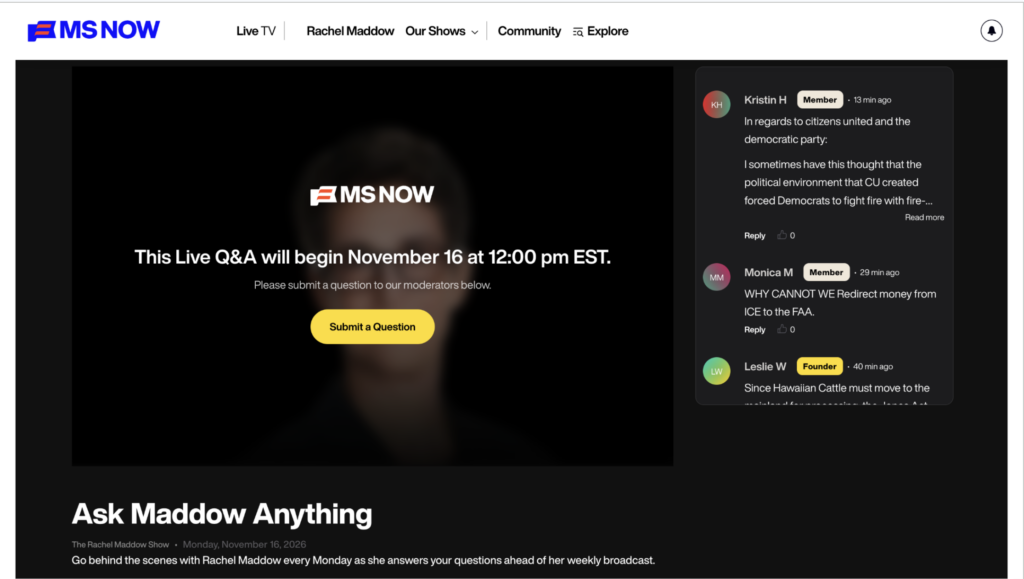
The third is premium access. Your most engaged readers should have a reason to log in that goes beyond getting past a paywall: early access, member conversations, live Q&As with reporters, and visible recognition for the people who contribute most. Incentives like these, as MS Now has shown, turn regular visits into something closer to belonging.
How to tell if you’re in
Pageviews won’t answer the question. A few other measures will.
- Loyal share: the percentage of your audience visiting 8 or more days out of 16, and whether it’s rising.
- Morning traffic: direct and app visits in the first hours of the day, which is about as close to a Top 5 test as you can get.
- Owned versus rented visits: how much traffic comes from newsletters, notifications, app opens and direct, compared with search and social.
- Logged-in rate: the share of your audience you can actually identify.
- Return interval: how quickly community members come back compared with everyone else, and whether that gap is narrowing.
Winning the morning
The referral years taught publishers to chase traffic. The next few years will reward the ones who become part of a reader’s routine.
You don’t have to be the first thing someone opens, but you do need to be in the first few. That’s where the relationship, the data and the revenue are. Anywhere else, you’re competing with every other tab on the internet for a few seconds of attention.
So picture your reader tomorrow morning. Alarm. Email. Text. Social. Search.
Then what?
If the answer isn’t you, that’s the problem worth working on.