
By: Mark Zohar
As audience depth replaces audience scale in the post-traffic era, media companies are turning their attention and their strategy toward “super users” — the small segment of people who fund most of the business. Grzegorz Piechota at INMA posted about this recently, and the numbers he shared are hard to look away from. Across 300+ brands in INMA’s Subscription Benchmarks, the top 1% of users generated 27% of all pageviews in Q2 2026, and 42% among the top-performing brands. Measured by revenue per user, he noted, the curve gets steeper still: at one of INMA’s European members, “the top 1% generated 81% of combined subscription and advertising revenue.”
The concentration is real, and executives are right to chase it. Spotify built an entire Investor Day around super users, and Piechota’s data shows how often the term now surfaces in public filings and analyst calls, with the line going nearly vertical in 2025 and 2026.
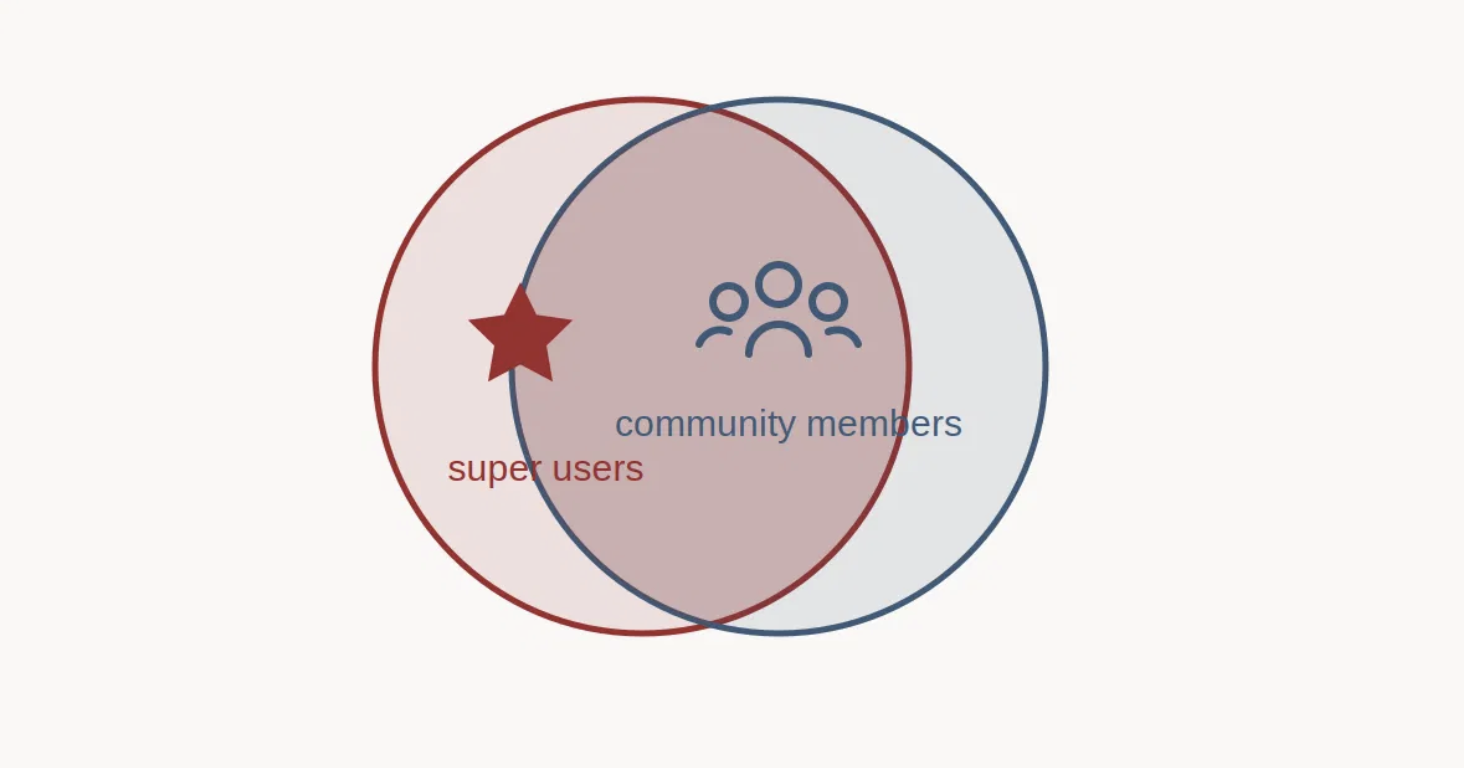
I’ve been watching this play out across our 1,000+ media brand clients at Viafoura, and here’s the part the industry hasn’t fully absorbed. The Venn diagram of super users and community members is a near perfect circle. These aren’t two audiences that happen to overlap. They’re largely the same people, described by two different departments that often don’t talk to each other.
Three shifts we’re watching in real time
Across our network, three market shifts have moved from theory to fact.
The post-traffic era is no longer theoretical. Publishing is moving from a traffic economy to a relationship economy, and you can measure it. Referral traffic is decaying. AI answer engines are absorbing the top of the funnel. The pageview as a unit of value is quietly dying. What replaces it isn’t more traffic. It’s deeper relationships with fewer people.
Audience depth is replacing audience scale — and the focus on super users is a clear response to this shift. The smartest publishers have stopped chasing pools of anonymous visitors and started building around smaller, identifiable, high-value audiences. Depth is the new organising metric, and it’s what makes the super-user concentration matter in the first place.
And community is moving from feature to infrastructure. Leaders aren’t bolting community onto the page anymore. They’re looking for products built around belonging, participation, and utility, because if the business runs on relationships, the systems that create those relationships can’t sit at the edge of the roadmap.
Same attributes, same person
A super user is defined by recency, frequency, and volume. Here yesterday, here tomorrow, dozens of visits a month, deep sessions. By loyalty, where the brand is part of their daily routine and not a tab they closed and never reopened. And by lifetime value that compounds across both revenue lines at once: a subscription that rarely churns, ad impressions generated day after day, plus events, gifting, and referrals.
Now describe a community member. The reader who comments, replies to another reader, follows a journalist, subscribes to a topic, asks a question. But also, the far larger group who never say a word: the ones who come back to read the comments, follow a live Q&A, and check how a poll landed. Contributing or just consuming, every one of those behaviours is recency, frequency, volume, loyalty, and habit, and all of it happens while they’re identified.
In data the Financial Times shared at a recent INMA webinar on Building Community With Reader Participation, readers who write comments are 4x more engaged than active readers who don’t post comments, and readers who only read the comments are still 1.6x more engaged than those who don’t.
The overlap with super users isn’t literally total, but it’s close enough that treating them as two separate audiences is a strategic mistake, and the exceptions shrink every year as more of the value moves to the people who come for the conversation.
There’s a third value line these readers generate, and it’s retention. In the same webinar session, the Financial Times reported that active community members have a roughly 25% higher retention rate than non-participants. That’s an LTV multiplier. Participation doesn’t only build habit and engagement. It makes readers more loyal, and harder to lose.
Your most engaged reader is your best subscription prospect, your most durable retained customer, and your single largest generator of ad inventory. One person. Every revenue line. The circle again.
The Frequency Loop: engineering the conditions for super users
Super users are developed, not found. But you don’t develop them by targeting them. You build a flywheel that reliably turns casual visitors into habitual ones, and then you let it run. Super users aren’t the input. They’re what emerges when the conditions are right. Your job isn’t to hunt the top 1%. It’s to engineer the frequency loop that keeps producing the next 1%. Community is what sets it spinning, and every stage exists to create the condition for the next one.
As I’ve previously noted, “Frequency is the metric that tracks habit formation. It’s the metric that signals brand loyalty. It’s the leading indicator of customer lifetime value, registration propensity, and subscription conversion.”
Participation is the fuel that powers the frequency loop; it separates a future super user from a bounce, and it’s the pivot the old funnel never had. That participation earns them a reason to come back — a reply, a live event, a thread heating up — delivered through a notification you own outright, with no algorithm in the middle. They return. Habit forms. Frequency climbs, and frequency is the leading indicator that makes everything downstream more likely.
Rising frequency is what converts. It turns into registration, subscription, and a paying relationship — identity, propensity, and intent handed to you along the way — and that generates revenue on both lines at once, extended by the higher retention active members deliver. Then the revenue funds better experiences and the sense of belonging pulls that reader back to the next article, bringing their replies, shares, and gifted stories with them to seed new visitors at the top. The loop closes, and starts again.
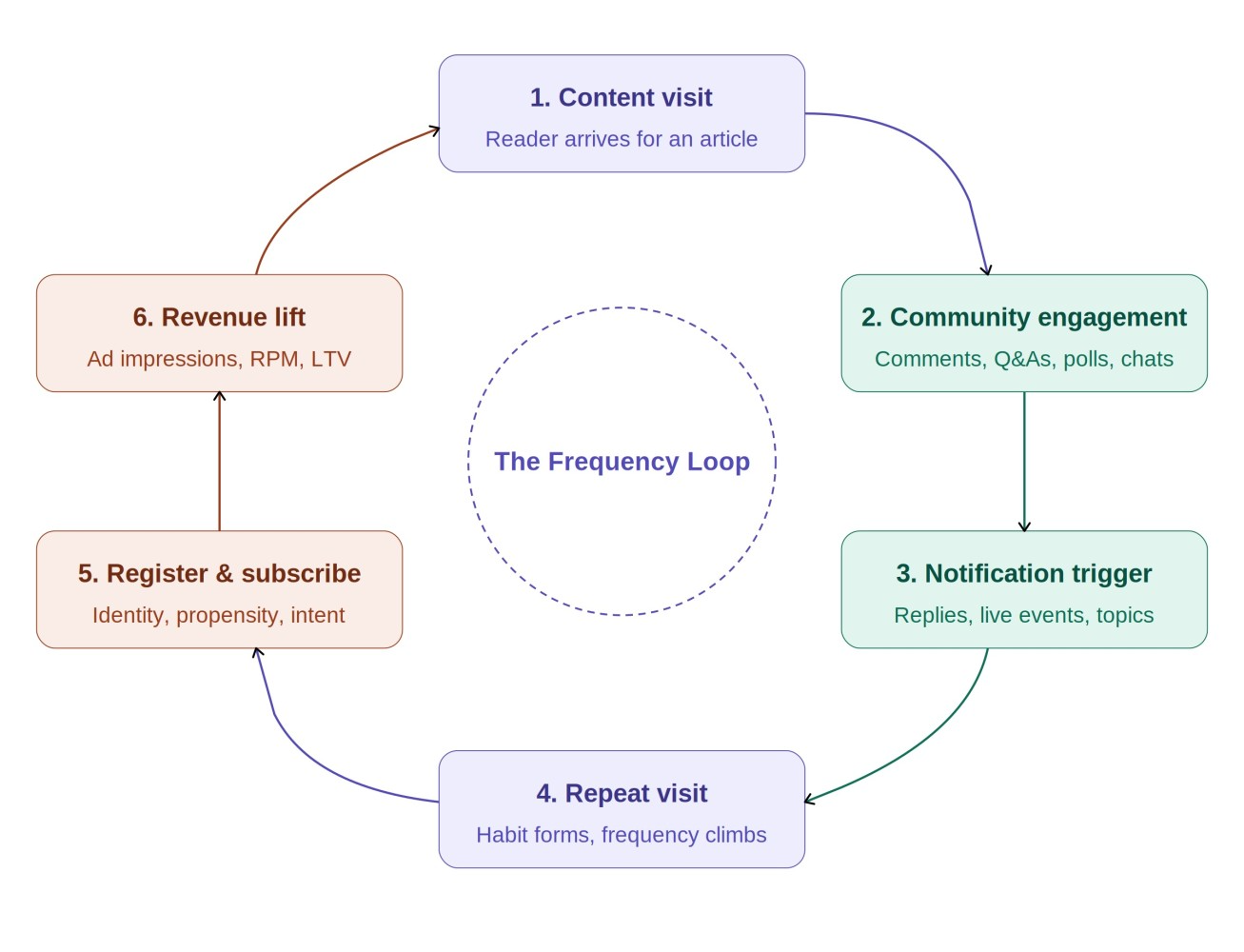
Every turn compounds and widens the base of people who could become super users. Identifying your existing top 1% with a dynamic paywall is worth doing, but it’s a rear-view exercise. It optimizes the loyal users you already have and manufactures no one new. The flywheel manufactures new ones. It doesn’t find super users. It creates the conditions where super users keep emerging. That’s why community can’t be a feature you bolt on. If the business runs on frequency, the system that generates frequency is core infrastructure.
You don’t acquire super users. You build them.
Every media CEO is asking some version of the same thing: how do we acquire more super users? The answer isn’t an acquisition strategy or a discovery exercise. It’s investing in the engagement hooks and flywheels that build daily habits, brand loyalty, and a deep, direct relationship with your audience. Community is one of the most effective ways to get there.
The traffic economy is ending. The relationship economy is already here. Super users aren’t a segment you acquire. They’re an outcome you engineer, one turn of the Frequency Loop at a time. And if the Venn diagram is a near perfect circle, then the fastest way to build more super users is to build more habit-forming community experiences.